This guide gives general information. It is not legal advice.
Summary: A Historic Area Work Permit (HAWP) is necessary for many types of work on the outer parts of a historic property in Montgomery County. An addition is one of these types of work. You must get the approval of the Historic Preservation Commission (HPC) for the application for the HAWP. You must send the application for the HAWP before you send the application for the building permit.
Is your property a historic property?
A historic property is a historic site or a property in a historic district. A property can be on one of two lists: the Master Plan for Historic Preservation and the Locational Atlas. The phone number of the Historic Preservation Office is 301-563-3400. The office tells you if your property is in one of the lists.
If your property is not in the Master Plan and is not in the Locational Atlas, a HAWP is not necessary. Then contact the Department of Permitting Services (DPS). DPS tells you if a building permit is necessary.
When a HAWP is necessary
A HAWP is necessary for these types of work:
- New construction and additions
- Grading, and the removal of live trees of more than six inches in diameter
- The removal or the enclosure of porches
- New siding, shingles or masonry facing, and other changes to the outer materials
- Work to replace a window sash with a new sash
- The permanent removal of shutters
- Changes to architectural features, for example changes to the dimensions, the shape or the position of windows
- The removal of paint from masonry, or new paint on masonry.
The list does not include all types of work. Montgomery Planning also shows these frequent HAWP applications:
- New fences, retaining walls, decks, walkways and patios
- The demolition of outbuildings, for example sheds and garages.
When a HAWP is not necessary
A HAWP is not necessary for work on the inner parts of a building or for gardening and landscaping. A HAWP is also not necessary when you select paint colors. A HAWP is not necessary for usual maintenance and repair of the outer parts, if the materials and the design do not change. If you are not sure, you can contact the Historic Preservation Office.
The steps for an addition
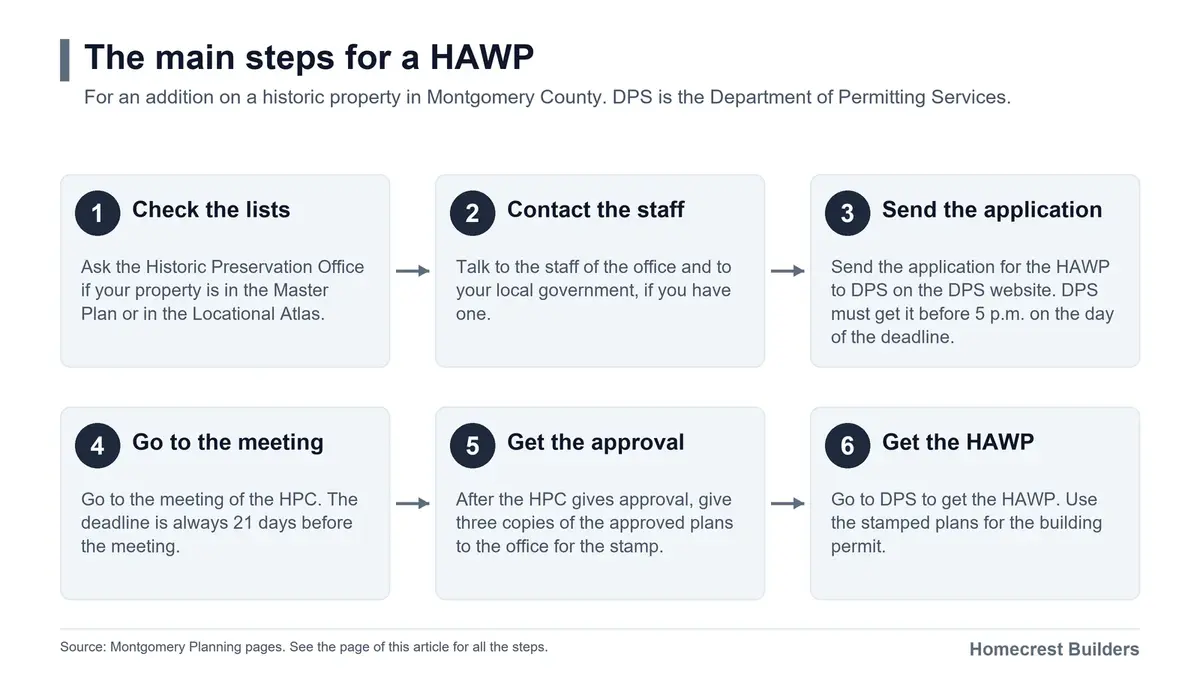
- Contact the Historic Preservation Office to know if your property is in the Master Plan or in the Locational Atlas.
- Before you send the application, contact the staff of the office about the work.
- Before you send the application, contact your local government, if you have one.
- Send the application for the HAWP to DPS on the DPS website. DPS sends the application to the staff of the Historic Preservation Office. The staff examines the application and sends it to the HPC.
- If a building permit is also necessary, send its application after you send the application for the HAWP.
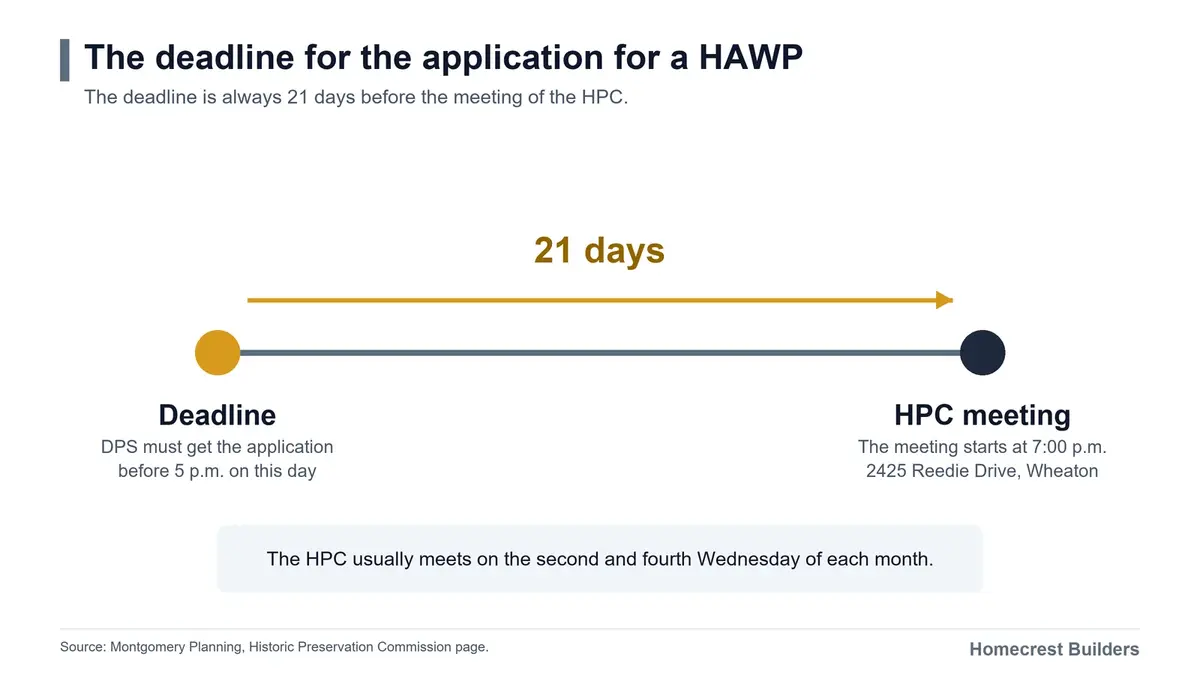
- Make sure that DPS gets the application before 5 p.m. of the day of the deadline. The deadline is always 21 days before the meeting.
- When you get the notice of the meeting, go to the meeting of the HPC. The notice gives the date and the location.
- After the HPC gives approval, give three copies of the approved plans to the Historic Preservation Office. The staff puts a stamp on the plans. The stamp shows the approval.
- Go to DPS to get the HAWP.
- If a building permit is also necessary, give DPS the plans that have the stamp. Do this when you get the building permit.
- If you do not accept the decision of the HPC, do one of these:
- Change the application. Then send it for a subsequent meeting of the HPC.
- Send an appeal to the County Board of Appeals.
Montgomery Planning recommends step 2 for large work.
Some local governments must examine the work before you send the application for the HAWP. Montgomery Planning shows these local governments as examples: Brookeville, Chevy Chase Village, Garrett Park, Kensington, Somerset and Takoma Park. The list does not include all local governments.
The dates of the HPC meetings
The usual day of the HPC meetings is Wednesday: the second Wednesday and the fourth Wednesday of each month. The meetings start at 7:00 p.m. The location is 2425 Reedie Drive in Wheaton. The page of the HPC gives the dates of the meetings and the deadlines for 2026.
The time for a decision
The pages of Montgomery Planning that we read do not give the total time from the application to the decision of the HPC. You send the application for the HAWP before you send the application for the building permit. A different page of this website gives the time for a building permit for an addition in Bethesda and Chevy Chase.
Questions and answers
Is a HAWP necessary to replace windows on a historic property?
Montgomery Planning gives a list of frequent HAWP applications. Work to replace windows is in this list. The list of work for a HAWP in this guide includes work to replace a window sash with a new sash. A HAWP is not necessary for a repair, if the materials and the design do not change.
Is a HAWP necessary for work on the inner parts of a building?
No. A HAWP is not necessary for work on the inner parts of a building.
Can you remove a tree on a historic property?
A HAWP is necessary when you remove a live tree that is more than six inches in diameter. Tree removal is also a frequent HAWP application. If you are not sure, you can contact the Historic Preservation Office. To remove a dead tree, a dying tree or a diseased tree, you can send an e-mail to the Historic Preservation Office. You can contact the office for the instructions for the e-mail.
Is a HAWP the same as a building permit?
No. If a HAWP is necessary, you must send the application for the HAWP before you send the application for the building permit. When you get the building permit, you give DPS the plans that have the stamp.
Do you want an addition for a historic property?
We can help you to schedule the work of your project. Request a Consultation.
Sources
The sources of the information are these pages of Montgomery Planning:
Stay in the loop
Get updates on our newest remodeling and construction projects — no spam, just great work.